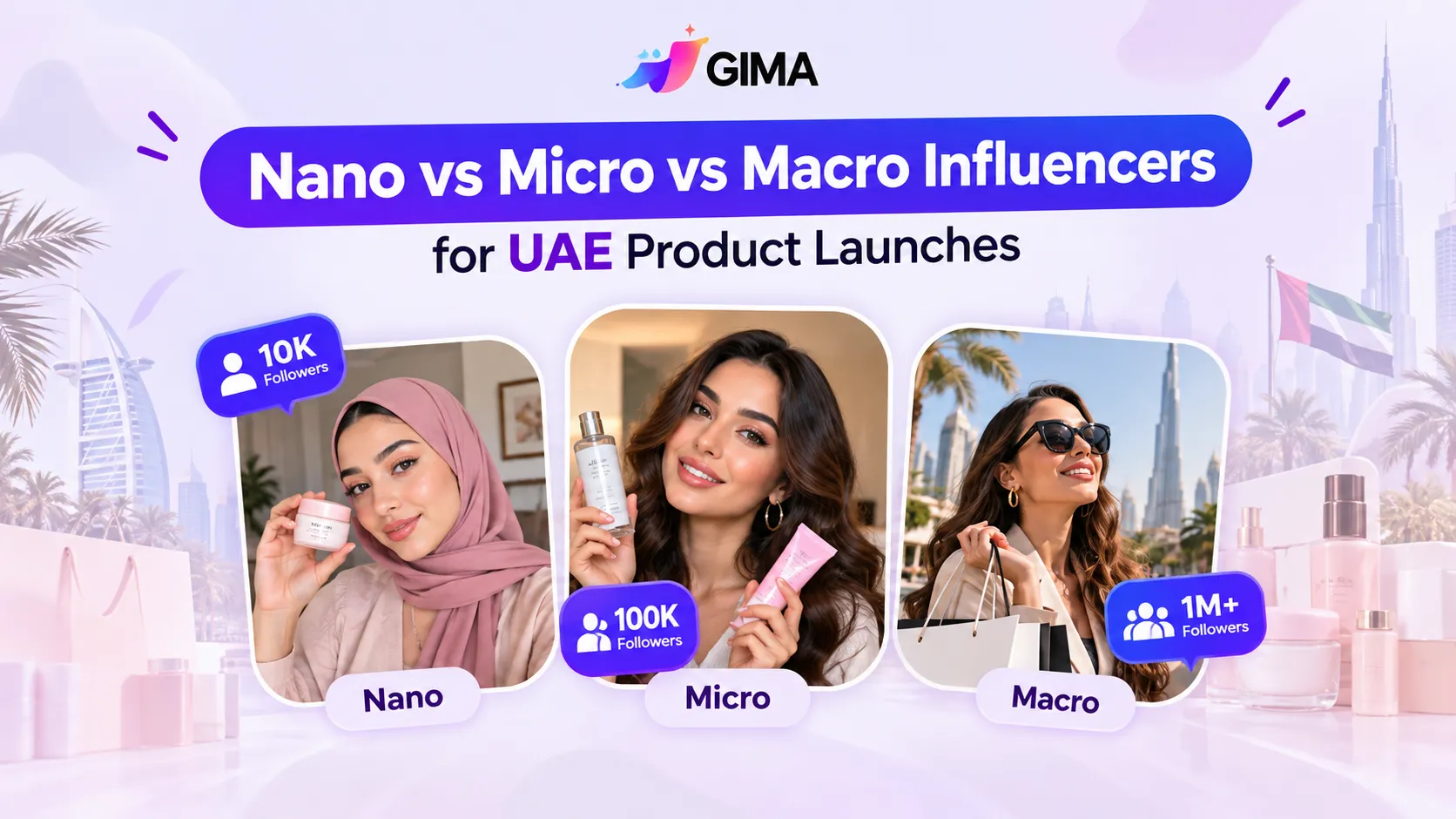
Why Influencer Tier Choice Makes or Breaks a UAE Product Launch
A product launch has one shot at a first impression. Get the influencer tier wrong and you either burn a budget on a reach that never converts, or you save money on nano creators but never build the awareness a new product needs to break through a crowded UAE market.
The tier you choose determines almost everything downstream: how authentic the campaign feels, how far it travels, and how much you'll spend to get there. A skincare brand launching in Dubai with a limited budget needs something very different from a mass-market F&B brand trying to get its name in front of as many residents as possible in the first month. Neither "more followers" nor "more engagement" is automatically the right answer. It depends on what your launch is actually trying to achieve.
This comparison breaks down nano, micro, and macro influencers on the criteria that actually matter for a launch: cost, reach, engagement, and fit, so you can allocate budget with confidence instead of guessing.
Quick answer: For most UAE product launches on a defined budget, micro influencers deliver the strongest return because they combine above-average engagement with genuine local trust, at a cost that allows you to work with several creators instead of just one. Macro influencers still earn their place when the goal is pure awareness at scale, and nano influencers work well for hyper-local, community-driven launches. Many of the best-performing launches use a blend rather than a single tier.
Nano, Micro, and Macro Influencers Defined: Reach, Cost, and Engagement at a Glance
Before comparing ROI, it helps to be precise about what each tier actually means. These follower thresholds are industry conventions, not fixed rules, but they're a useful baseline for planning.
| Tier | Typical follower count | Engagement rate | Relative cost | Best for |
|---|---|---|---|---|
| Nano | Roughly 1,000–10,000 | Generally the highest, driven by close personal audiences | Lowest, often product gifting or small fees | Hyper-local trust, community launches |
| Micro | Roughly 10,000–100,000 | Strong, above-average, still feels personal | Moderate, allows multiple creators per budget | Product launches needing both reach and authenticity |
| Macro | Roughly 100,000–1 million+ | Lower on average, but reaches far more people | Highest per post | Fast, broad brand awareness |
The pattern that holds across most markets, including the UAE, is that engagement rate tends to fall as follower count rises. A nano creator's audience is often friends, neighbours, and genuine fans, so a recommendation lands like advice from someone they know. A macro influencer's audience is broader and more passive, so the same post reaches many more eyeballs but with a smaller share of people actually stopping to engage.
For a product launch specifically, this trade-off between reach and engagement is the entire decision. You're not just buying visibility; you're buying the first wave of trust that determines whether people try the product at all.
Nano vs Micro Influencer ROI: Which Delivers More for Your Budget
This is the comparison most UAE marketing managers actually need to make, since nano and micro influencers are the two tiers most launches can realistically afford in volume.
Nano influencers typically cost the least, often working on gifted product or a small flat fee, and they usually post with the highest engagement rate relative to their following. Their cost per engagement can look excellent on paper. The catch is scale: reaching a meaningful audience with nano creators alone means coordinating a large number of individual partnerships, which adds real time and management overhead to a launch timeline.
Micro influencers sit in the sweet spot for most launches. Their engagement rate is still strong, noticeably above what you'd see from a macro account, but each partnership reaches a larger, more relevant audience than a single nano creator. That means a similar total budget can either go further per post, or let you work with fewer creators for less coordination effort while still getting meaningfully more reach per partnership than the nano tier offers.
The practical way to think about it: nano wins on cost per engagement in isolation, but micro usually wins on cost per outcome, because the audience size per partnership is large enough to actually move a launch's awareness and trial numbers without requiring dozens of separate relationships to manage. That's why so many UAE brands treat micro influencers as the default starting point for a launch budget, and reserve nano influencers for hyper-local add-ons rather than the core strategy.
Micro Influencers in the UAE: Why They're a Strong Fit for Product Launches
Micro influencers are where the UAE's specific market dynamics matter most. Dubai and the wider UAE have a dense, highly connected creator community across Instagram and TikTok, spanning both Emirati and expat audiences. That multicultural mix is exactly what makes the micro tier so effective here: a launch can select creators who speak directly to a specific community, whether that's the South Asian expat market, Western expats, or Emirati Gen Z, rather than relying on one macro creator to represent an audience that isn't actually homogeneous.
For a product launch, this specificity matters more than raw follower count. A new product needs people to believe the recommendation is genuine before they'll try it, and micro influencers in the UAE have generally built their following around a recognisable niche such as beauty, fitness, food, or parenting, so their audience already trusts their opinion in that category. Pricing for micro influencers in the UAE also tends to sit in a range that lets a brand commission several creators across different communities and platforms for the same overall budget that might otherwise go to a single macro post.
If you're trying to picture real options rather than an abstract category, and you're actively comparing micro influencers UAE has to offer, GIMA's roundup of top micro influencers in Dubai is a useful next step, since it profiles actual UAE-based creators across niches so you can see what a micro-influencer roster looks like in practice before committing budget.
When Macro Influencers Make Sense for a Launch
Macro influencers aren't wrong for a launch; they're just answering a different question. If your primary goal is to make sure as many people as possible in the UAE simply know your product exists, in the shortest possible time, a macro creator's reach is hard to replicate with several smaller partnerships.
This matters most for mass-market launches where broad brand awareness, not niche trust, is the immediate priority. A national F&B chain opening several new outlets across the UAE, for example, may need a macro influencer's single post to generate the kind of instant, wide-reaching buzz that a string of micro partnerships would take weeks to build. The trade-off is that engagement rate is typically lower and the content can feel less personally endorsed, so it works best as a top-of-funnel awareness push rather than the sole driver of trial and conversion.
Macro influencers also make sense when a launch has a hard deadline and a single, high-visibility moment, such as an event tie-in or a retail availability date, where the priority is maximum simultaneous reach rather than a slow-building, community-by-community rollout.
Matching the Tier to Your Launch: Budget, Goals, and Product Type
There's no universal "best" tier, only the tier that fits your specific launch. A few illustrative scenarios make this concrete:
A niche beauty brand launching a new serum in Dubai, with a limited budget and a need for genuine trust before people try a new skincare product, is usually better served by a cluster of micro-influencers in the beauty niche, possibly supported by a few nano creators for hyper-local buzz.
A mass-market F&B brand opening across multiple UAE emirates, prioritising fast, broad awareness over niche credibility, benefits more from one or two macro influencers to generate scale, paired with micro influencers to sustain engagement after the initial spike.
A community-focused product, such as a local fitness studio or a neighbourhood café, often gets the best return from nano influencers, since the goal is hyper-local word of mouth rather than nationwide reach.
When deciding, work through three questions in order: What is the campaign goal- awareness, trial, or both? What does the budget actually allow: one or two big partnerships or several smaller ones? And how much does this product depend on personal trust versus simple visibility to convert a first-time buyer? The answers will usually point you toward micro-influencers as the core of the strategy, with nano or macro added at the edges depending on your specific goals rather than treated as an either/or choice.
Executing Your Influencer Strategy in the UAE
Once you've settled on a tier, or more likely a blend, the harder part is execution: identifying the right creators, negotiating fair rates, briefing them so content still feels authentic, and tracking whether the campaign actually moved the needle on launch goals.
This is where most in-house teams run into friction, since sourcing and vetting influencers across tiers and niches in the UAE takes local market knowledge that isn't always available internally. GIMA, an influencer marketing agency working across Dubai, UAE, and the wider Middle East, shortcuts this process for brands: a vetted creator network spanning nano, micro, and macro tiers, plus the campaign management experience to run a multi-tier launch without the coordination becoming a full-time job in itself. GIMA's influencer vetting process walks through exactly how creators are evaluated before they're presented to a brand.
Whether your launch calls for a handful of micro creators, a single macro partnership, or a blended strategy across all three tiers, the goal is the same: match the tier to the outcome you actually need, then execute it with enough consistency that the campaign builds real momentum rather than a single scattered burst of posts. If you're planning a UAE product launch and want help mapping the right tier mix to your budget and goals, GIMA's team can walk you through it before you commit spend.